

LockBit Ransomware Trace & Analysis
Case study on the nefarious Lockbit Ransomware group
Intro
One of the most prolific threat cases that use blockchains to take and launder money is ransomware. The recent takedown of LockBit through Operation Cronos, a coordinated effort by law enforcement from 10 countries, provides a perfect case study for understanding how these criminal enterprises move money through cryptocurrency networks.
As a blockchain investigator, I analyzed one of LockBit’s Bitcoin addresses discovered through their leaked files, tracing a seemingly small $3,614 payment through a complex web of transactions that ultimately revealed a sophisticated money laundering operation worth tens of thousands of dollars.
Understanding the Ransomware Threat
Ransomware represents one of the most damaging forms of cybercrime, with groups like LockBit causing billions in global losses. Essentially these groups hack company databases and hold their sensitive files for ransom via encryption. These attacks follow predictable Tactics, Techniques, and Procedures (TTPs):
Tactics: Criminals gain initial access through phishing emails, compromised remote desktop protocols, or supply chain vulnerabilities.
Techniques: Once inside, they encrypt victim data, steal sensitive files, and often launch DDoS attacks — a strategy known as “triple extortion.”
Procedures: Modern ransomware operates as a service (RaaS), where core developers license their malware to affiliates who conduct attacks and typically keep 75% of ransom payments.
LockBit, which emerged in 2019, became the world’s most deployed ransomware variant by 2022. Their infrastructure was designed to resist takedown attempts, making Operation Cronos, which seized 34 servers across eight countries and froze over 200 cryptocurrency accounts, a significant victory for law enforcement.
Following the Money: A Real Investigation
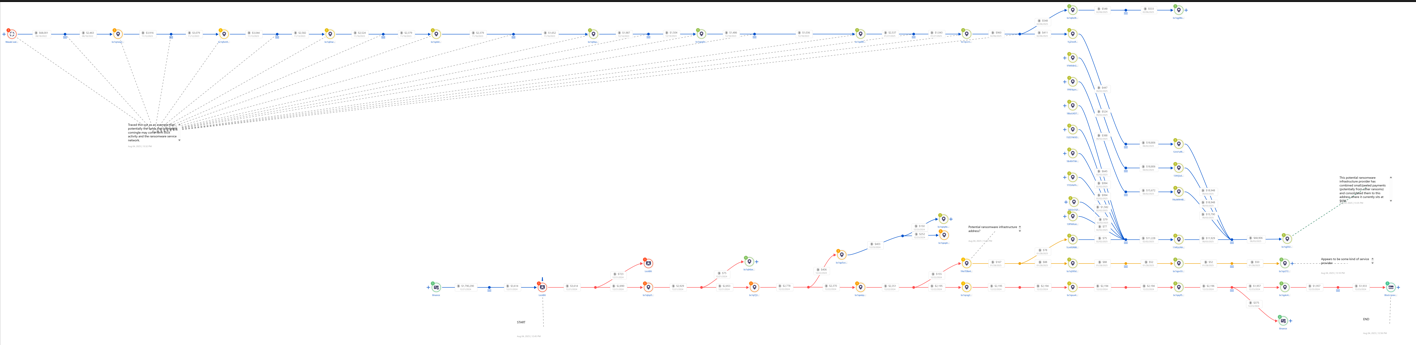
Through analysis of LockBit’s leaked files, I identified a Bitcoin address: bc1qgcfd2evmz4u0fyx3xsv7yft0p9fts06dunc0ec. While this address only received $3,614, following its transaction history revealed the broader ransomware financial network.
What the Analysis Revealed
The Peel Chain Pattern: The funds moved through a classic “peel chain” — a series of transactions where small amounts are systematically separated, typically to pay for infrastructure or operational costs while the bulk moves forward.
Infrastructure Payments: The yellow-coded transactions in my analysis show payments to what appear to be service providers, likely hosting, communication tools, or other operational necessities that keep ransomware operations running.
Fund Consolidation: Most telling was the blue-coded path showing how these smaller payments eventually commingled with others, ultimately concentrating in an address holding $69,000 that remains untouched.
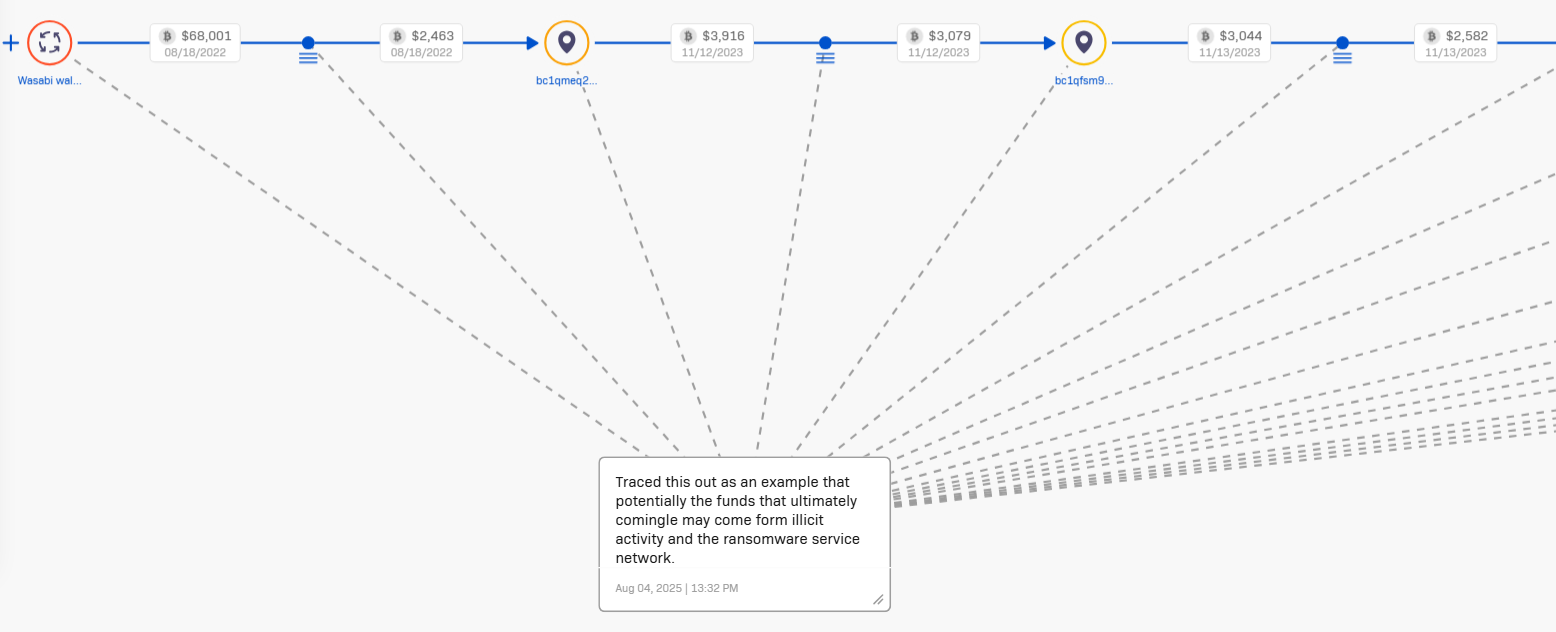
Sophisticated Obfuscation: One particularly suspicious trail showed unnecessary transaction hops originating from a Wasabi Wallet mixer, indicating a clear attempt to obscure the money’s origins.
Key Investigative Findings
The transaction patterns revealed several critical insights:
Operational Structure: The clear separation between infrastructure payments and profit demonstrates LockBit’s business-like approach to cybercrime. They maintain overhead costs while maximizing returns.
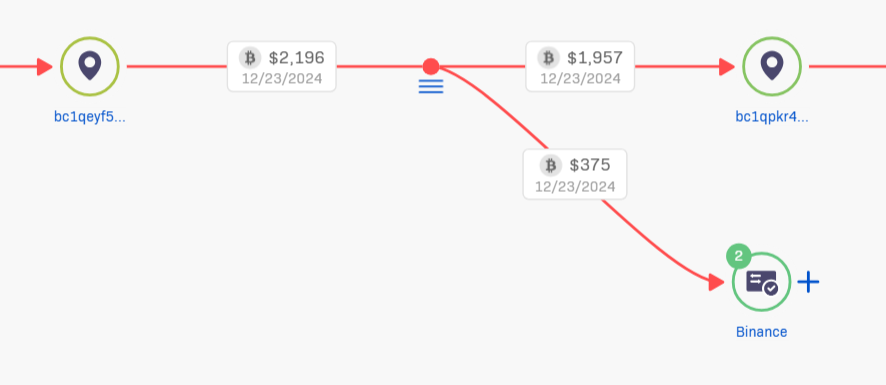
Exchange Connection: Perhaps most importantly, the trace revealed a Binance exchange connection just seven transaction hops away from the initial LockBit address. This represents a critical law enforcement opportunity, as exchange KYC records could potentially identify the individuals behind these transactions.
Money Laundering TTPs: The group employed layered transactions, strategic mixing with legitimate-appearing payments, and eventual consolidation to larger holding addresses — classic money laundering techniques adapted for cryptocurrency.
Vulnerability Points: Multiple chokepoints emerged where law enforcement could focus efforts: the Binance connection for KYC requests, infrastructure payment addresses, consolidation points with significant holdings, and mixer entry/exit points showing deliberate obfuscation.
Implications for Law Enforcement
This investigation highlights why blockchain analysis is crucial in combating ransomware. While criminals believe cryptocurrency provides anonymity, the permanent, public nature of blockchain transactions creates an investigative gold mine when analyzed properly.
Time-sensitive evidence: Unlike traditional financial crimes, blockchain evidence is immutable and timestamped, but rapid analysis is essential before funds move to exchanges or mixers.
Cross-referencing capabilities: Advanced clustering techniques can link seemingly unrelated addresses, revealing the full scope of criminal operations.
Proactive monitoring: Continuous surveillance of known ransomware addresses can provide early warning of new campaigns or help track existing investigations.
The Technical Challenge
Tracing ransomware funds requires sophisticated tools and methodologies. This investigation employed transaction graph analysis, address clustering, mixer detection, and exchange identification protocols. Each technique builds upon the others to create a comprehensive picture of the criminal financial network.
The LockBit case demonstrates that even small initial payments can lead to significant discoveries when proper blockchain investigation techniques are applied. What started as a $3,614 transaction revealed a $69,000 concentration point and exposed the operational structure of one of the world’s most dangerous ransomware groups.
Moving Forward
Operation Cronos dealt a significant blow to LockBit, but other ransomware groups continue to emerge. As these criminals become more sophisticated in their blockchain usage, law enforcement and private sector investigators must stay ahead with advanced analytical capabilities.
The key to successful ransomware investigations lies in rapid response, proper technical expertise, and understanding that every cryptocurrency transaction tells a story — you just need to know how to read it.
For organizations facing ransomware attacks or law enforcement agencies building cybercrime capabilities, remember that the blockchain evidence is waiting to be uncovered. The question isn’t whether the money can be traced, it’s whether you have the expertise to follow the trail before it goes cold.