


Executive Summary
In the wake of the massive $1.4 billion Bybit exchange hack attributed to the Lazarus Group, a remarkable recovery operation unfolded that saved $43 million worth of cmETH tokens. This case study examines the technical mechanisms that enabled the Mantle team to recover stolen funds within hours, while exploring the broader implications for decentralization in DeFi protocols.
Key Takeaways:
The 8-hour withdrawal delay built into the mETH protocol provided crucial response time
Smart contract permissions allowed for emergency intervention and fund recovery
The incident highlights the ongoing tension between security and true decentralization
Background: The Bybit Hack Context
On February 21, 2025, cryptocurrency exchange Bybit suffered what became the largest exchange hack in crypto history, with the Lazarus Group stealing approximately $1.4 billion across multiple cryptocurrencies. Among the stolen assets were 15,000 cmETH tokens (Mantle’s liquid restaking token), worth approximately $43 million at the time.
Unlike many hack scenarios where funds are immediately lost, this case presented a unique recovery opportunity due to the specific mechanics of the mETH protocol and the attackers’ apparent misunderstanding of how the system worked.
The Technical Breakdown: How the Recovery Unfolded
Understanding cmETH and the Withdrawal Mechanism
To understand how the recovery was possible, it’s essential to grasp the relationship between cmETH and mETH tokens:
cmETH: Mantle’s liquid restaking token, highly illiquid and difficult to exchange
mETH: The more liquid equivalent that hackers presumably wanted
8-hour withdrawal delay: Built-in security feature requiring time between withdrawal requests and token release
The hackers, seeking to convert their illiquid cmETH into more tradeable mETH tokens, triggered the withdrawal process that ultimately enabled their downfall.
Transaction Pattern Analysis
Analysis of the “Bybit Exploiter 4” address reveals a telling pattern of behavior:
First attempt: 15,000 cmETH withdrawal request
Second attempt: 6,000 cmETH (when the first didn’t immediately process)
Third attempt: 9,000 cmETH (continuing the same flawed strategy)
This behavior suggests the attackers didn’t understand the 8-hour delay mechanism, interpreting the lack of immediate token delivery as a transaction amount issue rather than a time-based security feature.
The Recovery Transaction Deep Dive
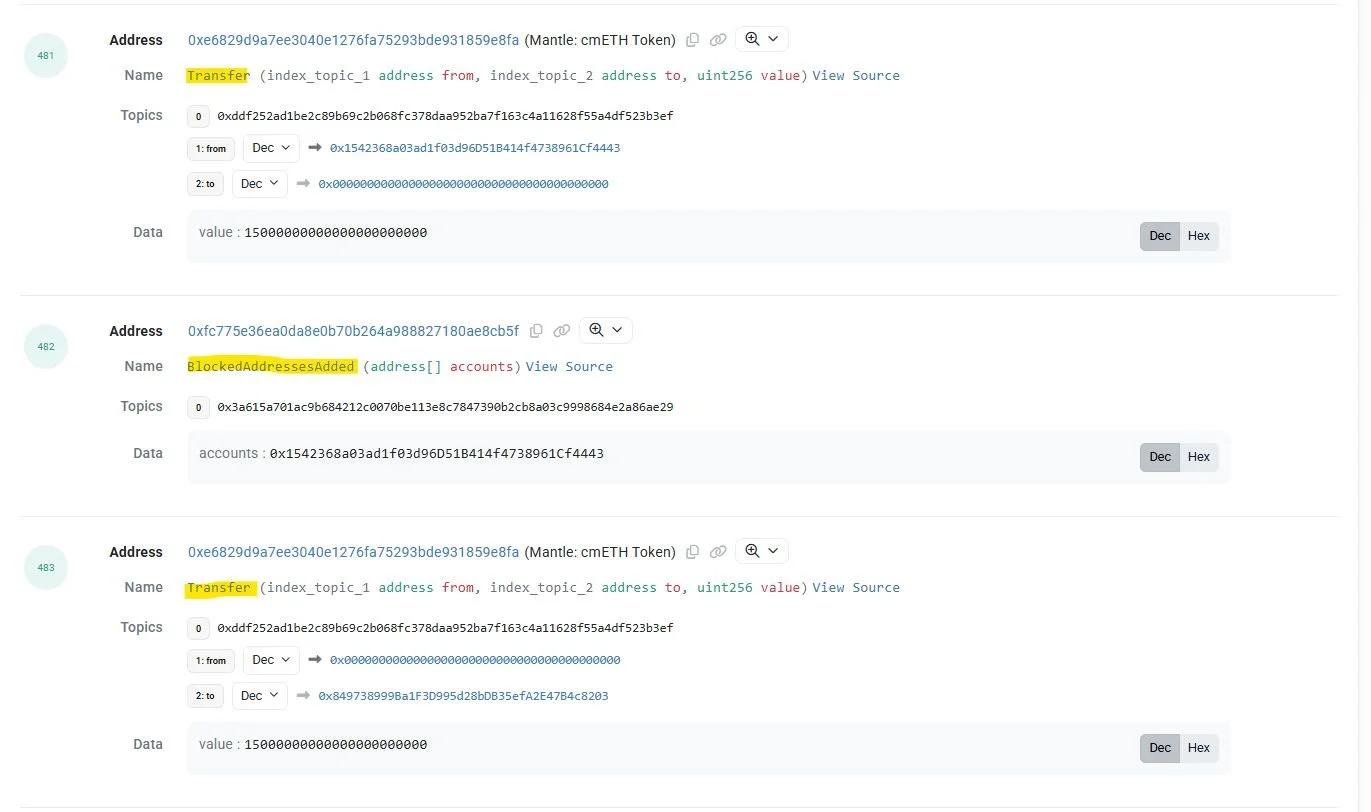
The critical recovery transaction (0x33c35bc4c0e152ce8c08dca2291a8ed0a20c87bc696260b2cf749d10fa3e5a12) provides a fascinating look at how modern smart contracts can be used for emergency interventions. The transaction logs reveal a carefully orchestrated 9-step recovery sequence:
Step-by-Step Recovery Process:
Permission Escalation: The Mantle team temporarily gained special administrative permissions
Address Management: Removed the hacker’s address from the existing blocklist
Token Burn: Executed a “burn” (transfer to null address) of the 15,000 cmETH from the hacker’s wallet
Re-blocking: Immediately re-added the hacker’s address to the blocklist
Token Minting: Minted fresh 15,000 cmETH tokens to their designated recovery wallet
Permission Revocation: Removed the temporary administrative permissions
Fund Return: Transferred the recovered tokens back to Bybit’s deposit address
The entire process was completed within hours, demonstrating both the effectiveness of the protocol’s emergency mechanisms and the rapid response capabilities of the Mantle team.
Zoom image will be displayed
Key Players in the Recovery
The successful recovery involved coordination between multiple parties:
Mudit Gupta (Polygon CISO): Identified the recovery opportunity
SEAL Security Team: Provided rapid-response security expertise
Mantle Team: Executed the technical recovery process
Bybit: Potential $4.3 million recovery bounty under their recently announced program
This multi-party collaboration highlights the importance of having established relationships and communication channels within the crypto security ecosystem.
Comparative Context: Why This Recovery Matters
The $43 million Mantle recovery is significant not just for its dollar amount, but for its speed and methodology. To put this in perspective:
Ronin Bridge Recovery (2022): $30 million recovered over 6 months with law enforcement assistance
Mantle Recovery (2025): $43 million recovered in hours through smart contract intervention
This represents a new paradigm in crypto fund recovery, where technical solutions can outpace traditional legal and law enforcement approaches.
The Decentralization Dilemma
While the successful recovery is undoubtedly positive, it raises fundamental questions about the nature of decentralization in modern DeFi protocols:
The Security vs. Decentralization Trade-off
Arguments for Emergency Powers:
Enables rapid response to security incidents
Protects user funds from sophisticated attackers
Demonstrates responsible protocol governance
Arguments Against Administrative Control:
Contradicts core principles of decentralization
Creates single points of failure
Enables potential abuse of power
Implications for Protocol Design
This incident forces us to confront an uncomfortable truth: truly decentralized protocols may be inherently less secure than those with carefully designed administrative controls. The Mantle team’s ability to recover funds relied on:
Centralized administrative permissions
The ability to freeze, burn, and mint tokens
Time-delayed mechanisms that create intervention opportunities
Lessons for the Industry
For Protocol Developers
Time delays as security features: The 8-hour withdrawal delay proved crucial for recovery
Emergency mechanisms: Well-designed administrative controls can save user funds
Transparency in permissions: Users should understand what administrative powers exist
For Security Teams
Rapid response capabilities: Having established procedures and relationships enables faster intervention
Technical literacy: Understanding protocol mechanics can reveal recovery opportunities
Cross-team collaboration: Complex recoveries require coordinated expertise
For Attackers (and Defenders)
Protocol knowledge matters: The hackers’ misunderstanding of the withdrawal delay enabled the recovery
Time-based security: Delays create opportunities for intervention
Smart contract permissions: Administrative controls remain a significant risk factor for attackers
Looking Forward: The Future of Fund Recovery
The Mantle recovery demonstrates that the crypto ecosystem is evolving beyond simple “code is law” principles toward more nuanced security models. This evolution presents both opportunities and challenges:
Emerging Trends
Hybrid governance models: Balancing decentralization with emergency intervention capabilities
Cross-protocol coordination: Enhanced cooperation between security teams
Technical recovery methods: Smart contract-based solutions complementing legal approaches
Open Questions
How can protocols maintain decentralization while preserving security features?
What governance models best balance user protection with trustless operation?
How will attackers adapt to these new recovery capabilities?
Conclusion
The $43 million Mantle recovery represents a significant milestone in crypto security, demonstrating that well-designed protocols and rapid response capabilities can successfully counter even sophisticated state-sponsored attackers. However, it also forces us to reconsider fundamental assumptions about decentralization in DeFi.
As the crypto ecosystem continues to mature, we’re likely to see more protocols adopting similar hybrid models that balance security with decentralization. The key will be ensuring these powers are used responsibly and transparently, maintaining user trust while providing necessary protections.
The philosophical tension between security and decentralization isn’t easily resolved, but cases like this provide valuable data points for ongoing industry discussions. What’s clear is that the binary choice between “fully decentralized” and “centralized” is giving way to more nuanced approaches that prioritize user protection while preserving the core benefits of blockchain technology.